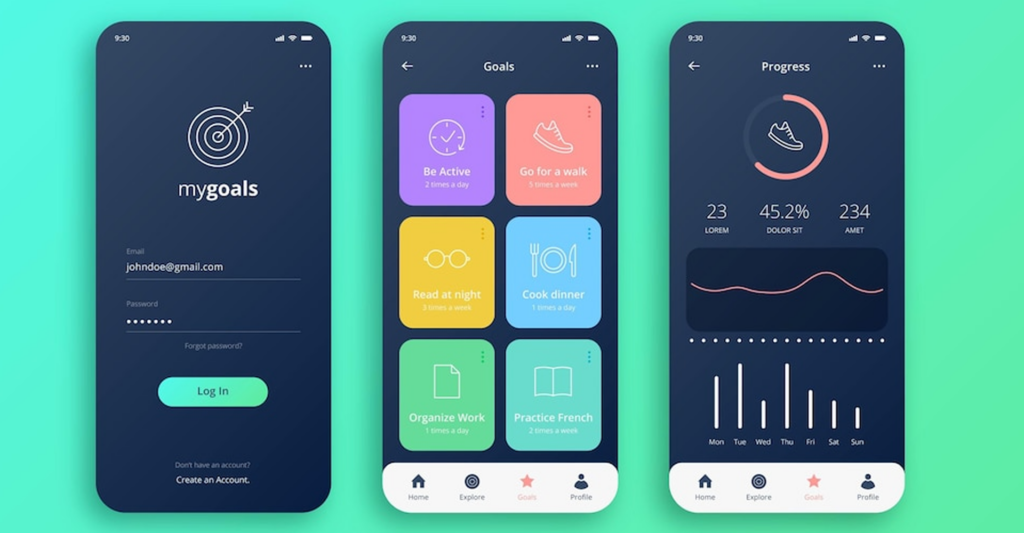
LA apps are everywhere: from entertainment to fitness to services to retail, almost every business has its own app. Because of that, visual quality is the baseline expectation, not the differentiator. What separates successful apps from failed ones usually has almost nothing to do with technology and a whole lot more to do with how people actually behave when using your app. The biggest risk is not building the wrong features; it’s building an app that doesn’t fit people’s lives.
Los Angeles users are used to slick design. That said, they are also really impatient with anything that feels clunky. If an app is not intuitive, most people will simply delete it. You have seconds, not minutes, to prove your app deserves space on someone’s very crowded phone.
How app decisions are made in Los Angeles
In LA, people decide whether to keep an app almost instantly based on how it feels and how it operates. If the experience is smooth and elegant, adoption can spread pretty quickly through social circles. If it’s confusing or slow, the reputation damage happens just as fast and the app goes nowhere.
You’re not competing with other small LA apps; you’re competing with Instagram and Uber in people’s minds. It’s an extremely high bar for a relatively small business.
We’ve seen companies spend a fortune building powerful tools, only to discover that users stopped using them because the interface felt overwhelming or confusing.
Where leadership usually gets this wrong
One of the most common mistakes in creating apps in the Los Angeles market is assuming that more features make a better product. In reality, users want simplicity, speed, and clarity. They are not going to stare at an app for 10 minutes to figure out which button to push or press 23 buttons to get where they need to go.
It is very easy to build something technically brilliant, but if real people don’t want to use it, it has already failed.
When leadership pushes for more features instead of better usability, the team ends up rebuilding the same app multiple times. The only way to avoid this is to start the conversation with app builders and your team from the point of view of what is going to make your LA apps most useful for your clients, not what is going to make it the most complicated Swiss army knife design you can imagine.
What actually works in LA apps
Apps that succeed in Los Angeles are the ones that feel obvious to use. They solve one clear problem well rather than trying to do everything. Again, you are competing against Spotify and Uber, not against your local restaurant, massage parlor, or radio station. In the mind of LA app users, you are competing against every other app on their phone.
Successful teams treat every early user like a gift. They watch how people actually behave instead of assuming how they are going to behave. One of the things we’ve discovered over the years since we started putting LA apps on phones is that you can’t alter people’s behavior; you have to operate within the normal behavior of your clientele. Something can be creative and interesting, but if it feels unpredictable or unlike every other app on their phone, people simply won’t use it.
A million downloads mean nothing if users stop using the app after a week. You want to make the app so simple that it becomes part of their everyday routine.
Why this approach feels simple but isn’t
The best apps feel effortless. Getting there requires incredibly brutal clarity about what you will not build. This requires real experience with how people actually use apps and what they expect from them.
The most successful apps are defined as much by what they exclude as by what they include.
Who this approach is not for
This approach does not work well for organizations that fall in love with their own ideas rather than those of their users. It is not possible to succeed by creating an app that makes your team feel good but leaves users confused or frustrated.
How LA apps compare to other markets
In other parts of the country, users are more patient with utility, but LA apps users want elegance. While New York may care more about speed and practicality, LA users care deeply about how an app feels.
It is imperative to design an app that not only does what it needs to do but also looks really good. In a city full of people in film, media, and digital production, everyone knows what quality design looks like.
Conclusion
The LA apps that last longest are not the most complex or the flashiest. They’re the ones that fit seamlessly into how people actually live and provide an attractive, practical gateway to your company and your product.
FAQs for SEO
1. Why do so many apps fail in Los Angeles?
Most LA apps fail because they prioritize features over real user behavior. LA users expect beautiful design and frictionless usability, and they abandon apps quickly if either is missing.
2. What matters more in LA apps: design or functionality?
Both matter, but usability comes first. Great design helps capture attention, but clear purpose, simplicity, and smooth experience determine whether users actually keep the app.
3. Are downloads a good measure of success for LA apps?
No. Retention and regular use matter far more than downloads. An app that people return to weekly is far more valuable than one that is downloaded once and never opened again.